
By: Erin Powers, Vice President, Subrogation Business Solutions
Executive Summary
Subrogation has always been a discipline of details. The work depends on facts, timing, documentation, liability decisions, negotiation strategy, and the ability to defend a recovery position. But in today's auto claims environment, the details are proliferating as U.S. auto claims become more complex.
Vehicle technology, diagnostics, calibrations, and repair procedure requirements are adding more variance to repair estimates and driving more supplements, creating space for more disputes, contention, and litigation. At the same time, carriers are expected to maintain recovery performance as institutional knowledge leaves or retires from the organization and newer employees with less subrogation-specific experience step into increasingly complex work.
To better understand this shifting landscape, CCC Intelligent Solutions commissioned a national benchmarking study, The Future of Auto Subrogation Claims Operations, conducted by Hanover Research.
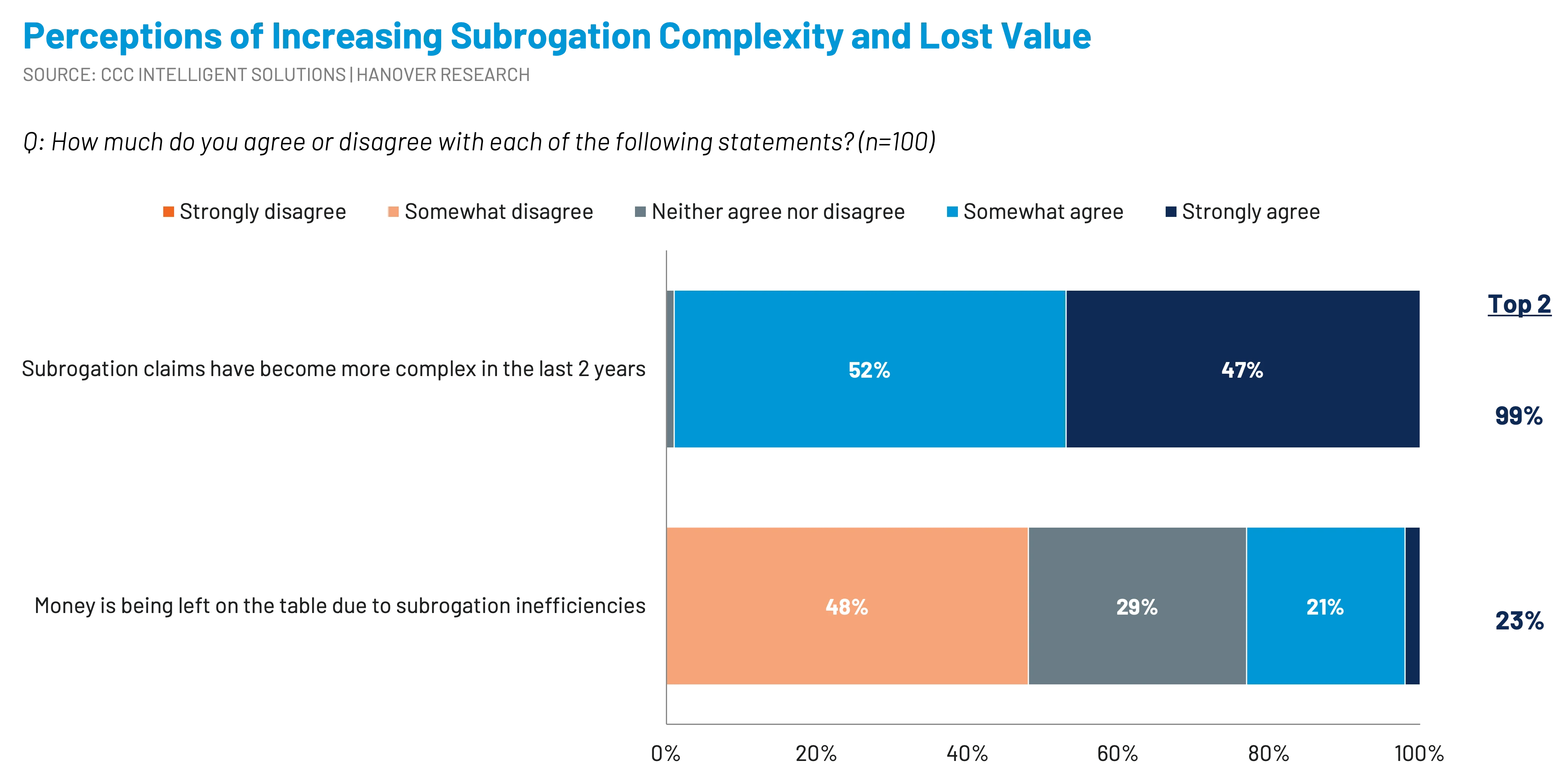
Our study found that 99% of U.S. insurance leaders overseeing auto physical damage (APD) subrogation operations believe claims have become more complex over the past two years.
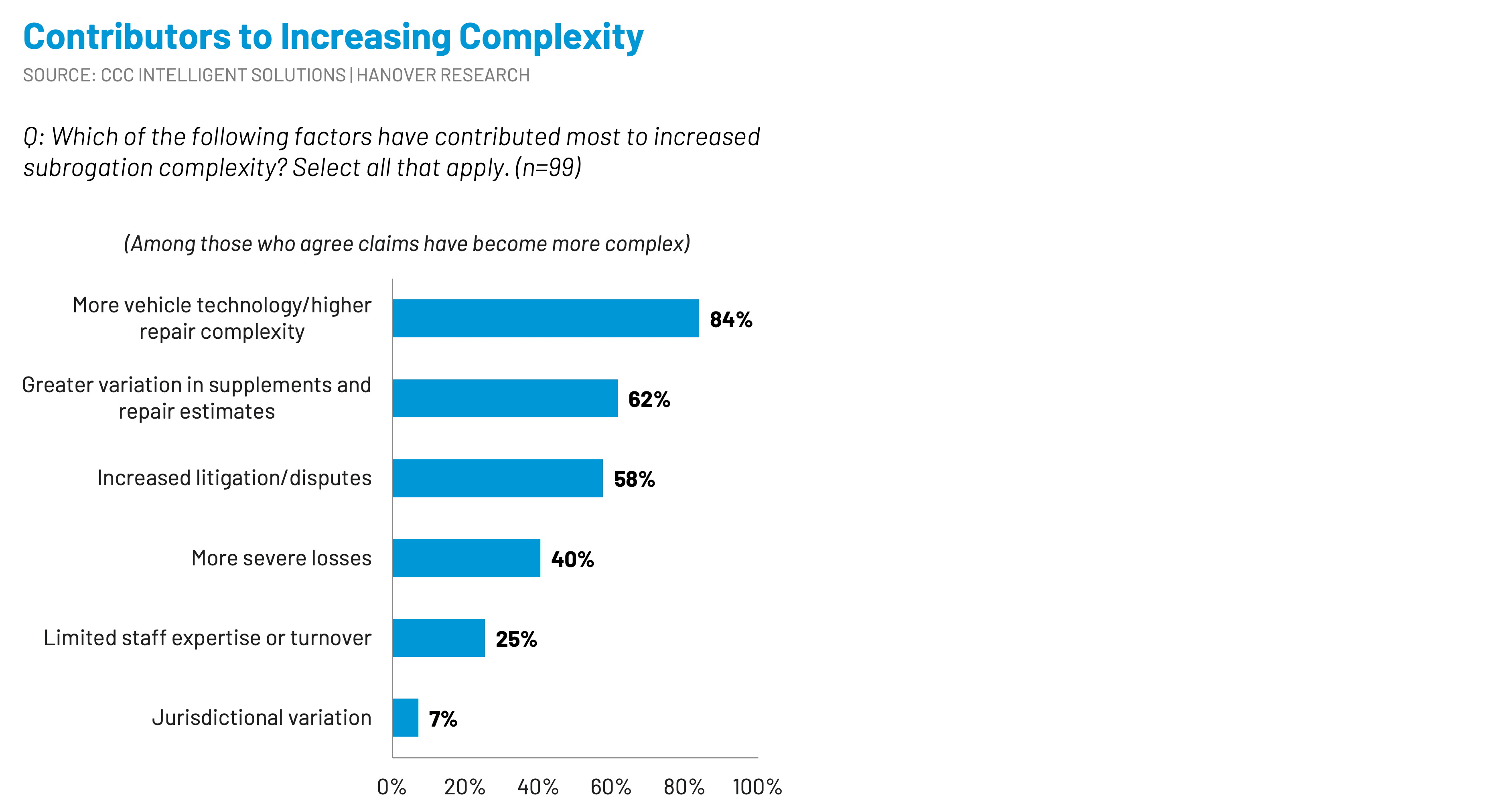
The biggest drivers were more vehicle technology and higher repair complexity, cited by 84% of respondents, followed by greater variation in supplements and repair estimates at 62% and increased litigation and disputes at 58%.
These findings confirm what many industry leaders are already seeing day to day: subrogation has evolved beyond a traditional back-office recovery function, becoming a more complex, operationally demanding, and strategically critical part of claims performance.
Complex Claims Are the New Normal
For years, subrogation teams have managed a familiar mix of liability disputes, estimate disagreements, documentation gaps, and arbitration preparation. What has changed is the frequency, intensity, and technical complexity of those challenges.
Modern vehicles have changed both the economics and evidentiary demands of APD claims. While accurate repair estimates can be generated up front, once repairs are in progress, there may be more specialized labor, calibration requirements, and electronic component considerations, leading to variation between the initial estimate and final repair cost.
For subrogation teams, repair complexity presents a much larger recovery challenge. Teams must understand not only what was repaired, but why it was necessary, whether each line item is defensible, whether documentation supports the demand, and how to respond when another carrier challenges the amount. A file that may once have been considered straightforward now requires deeper familiarity with repair procedures, estimate logic, liability facts, and negotiation strategy.
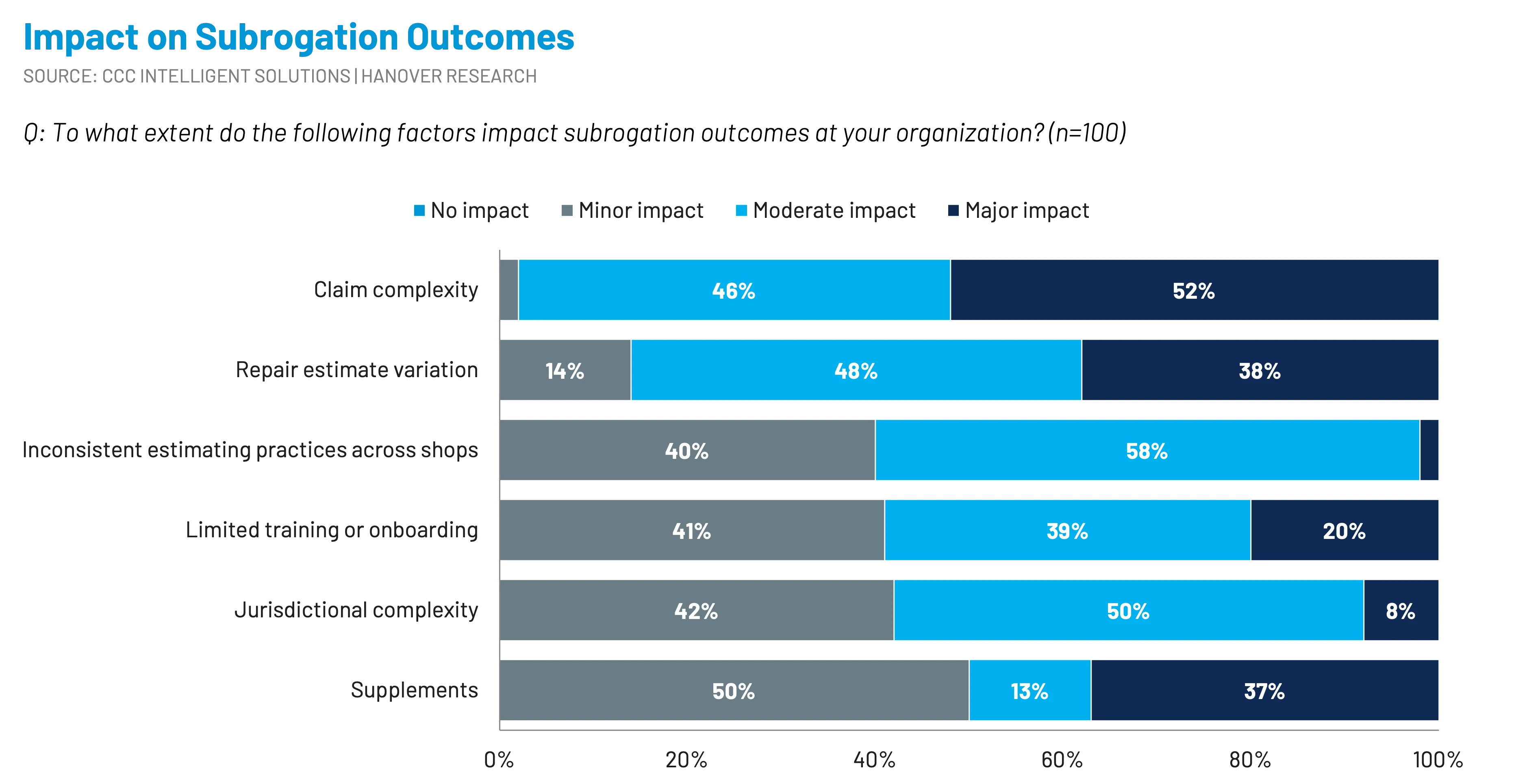
CCC’s study found that 98% of organizations believe claim complexity has a moderate or major impact on subrogation outcomes, and 86% said the same of repair estimate variation.
Compounding this complexity is volume. Many study participants reported significant annual subrogation volumes, with 35% handling 120,000 or more outbound claims and 41% handling 120,000 or more inbound claims per year.

At that scale, even small inconsistencies in identification, documentation, liability review, or negotiation strategy can materially affect performance.
The Skills Gap is Showing Up in Critical Win-or-Lose Moments
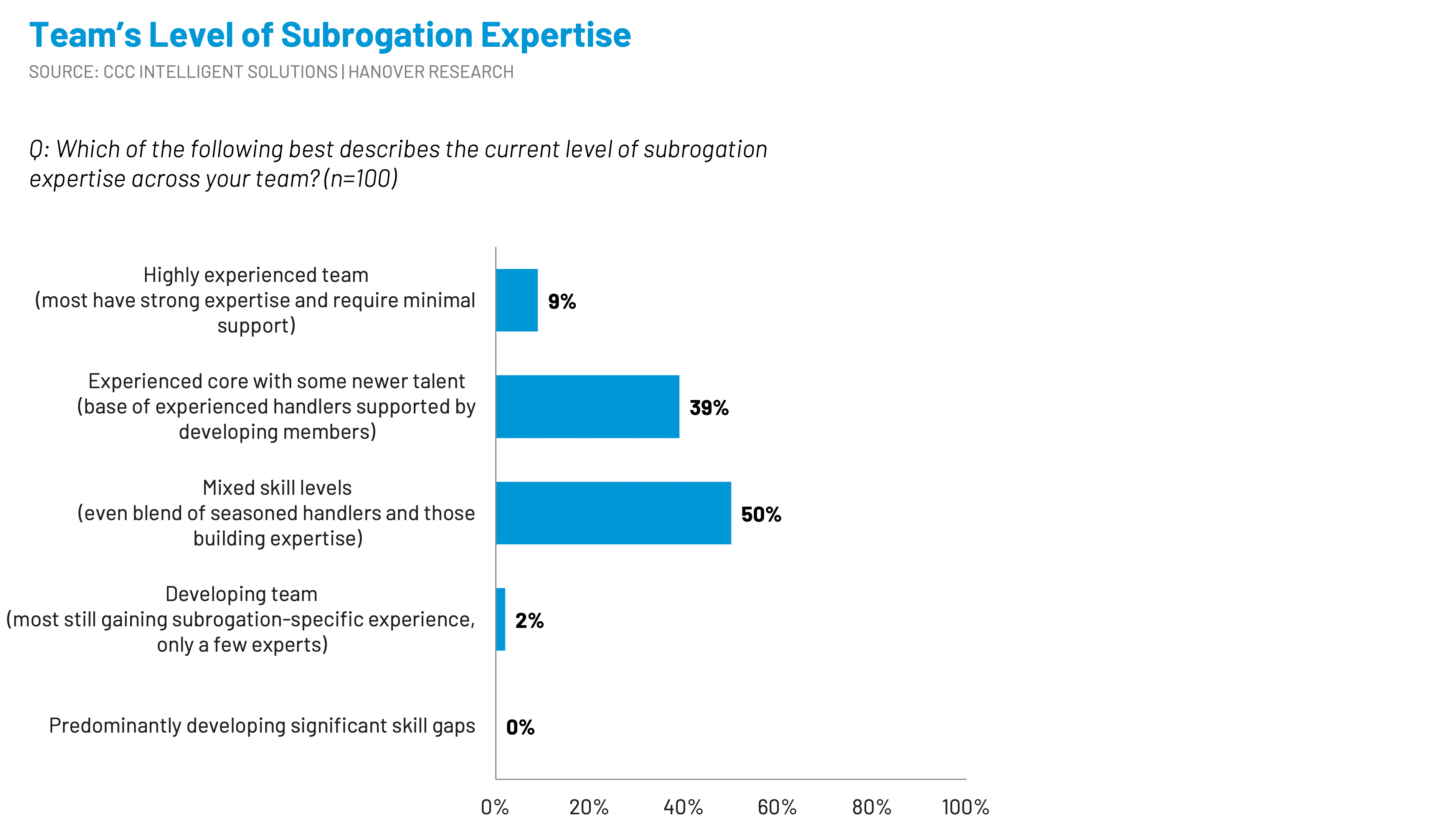
Most subrogation teams are not operating with uniform levels of expertise. In the study, 50% of respondents described their teams as having mixed skill levels, while 39% said they have an experienced core supported by some newer talent. Only 9% said their teams are highly experienced and require minimal support.
This finding aligns with broader claims workforce trends. CCC's 2025 report, Closing the Subrogation Skills Gap with Intelligent Guidance, noted that more than 50% of first-party adjusters at some carriers have less than two years of experience.
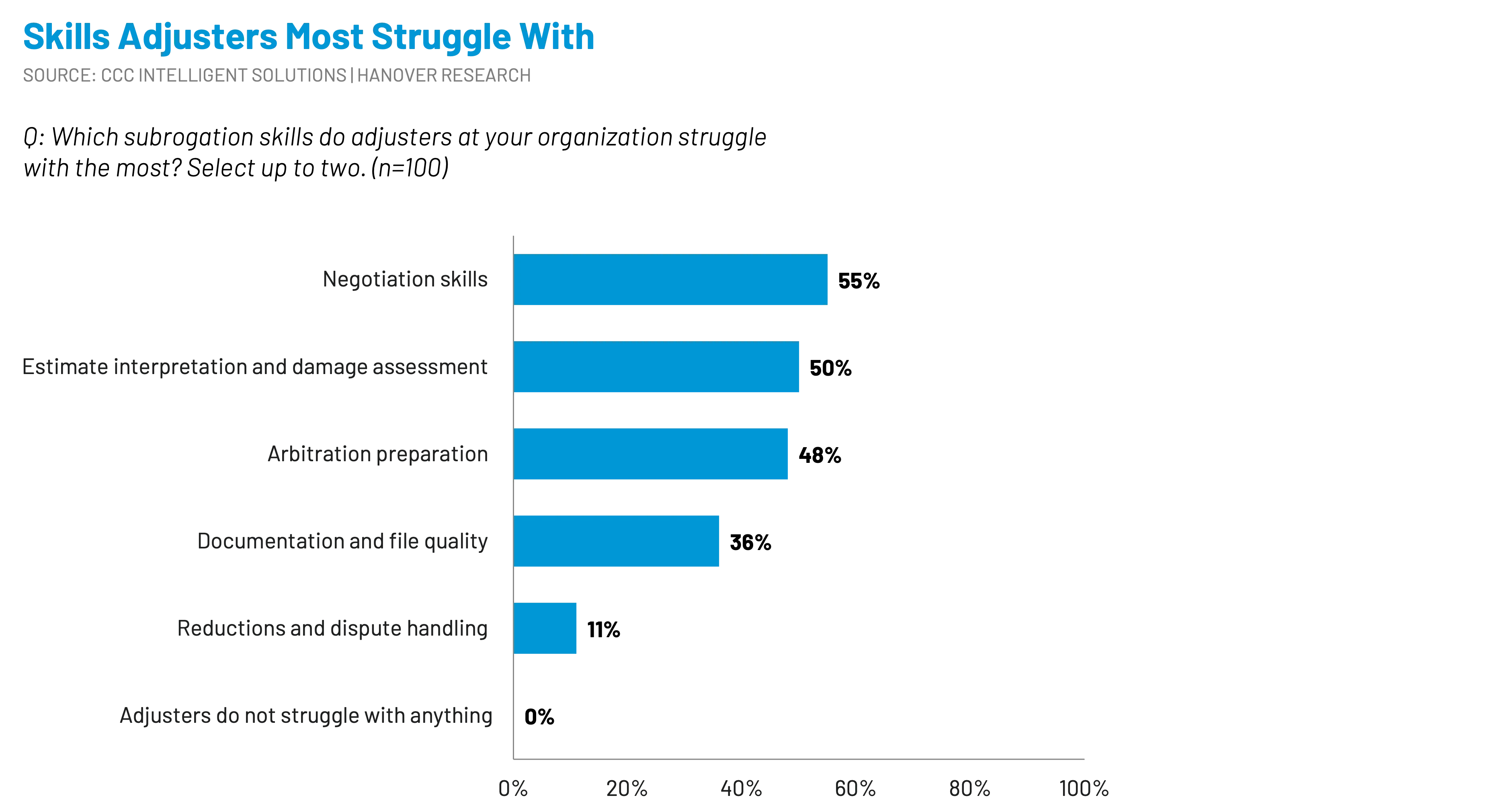
According to 55% of our study respondents, subrogation teams struggle most with negotiation skills. Estimate interpretation and damage assessment followed at 50%, and arbitration preparation was cited by 48%.
These are not ancillary tasks – they're the moments where a recovery position either strengthens or begins to erode, and they're often the determining factors for whether:
- A demand is complete
- Disputed line items are defended effectively
- Liability arguments are persuasive
- A file continues through negotiation or escalates to arbitration
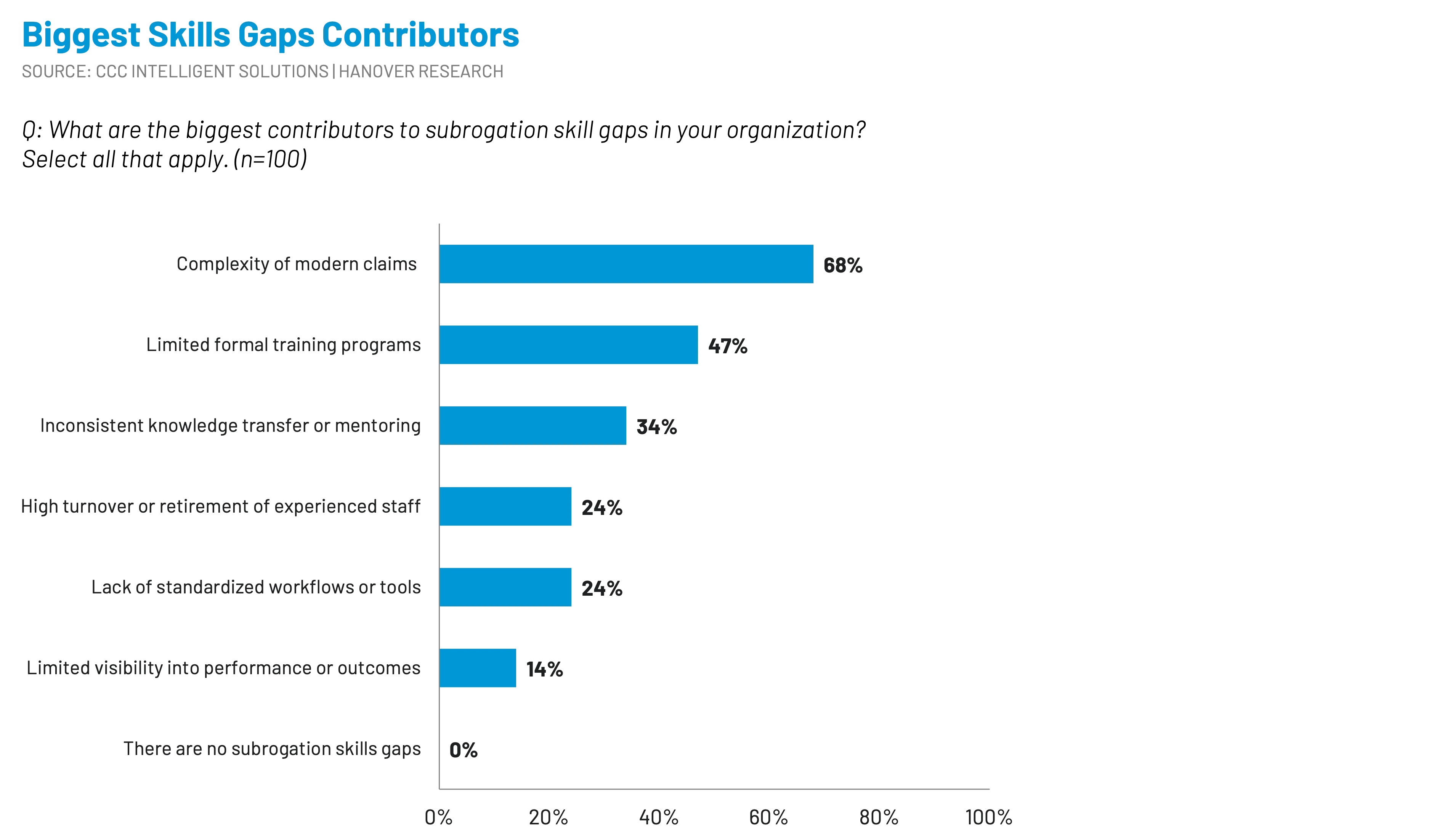
When asked what's driving these skill gaps, respondents pointed first to the complexity of modern claims (68%), followed by limited formal training programs (47%), and inconsistent knowledge transfer or mentoring (34%). This suggests the issue is not simply that teams need more training. It's that the work itself is changing faster than traditional training and knowledge-transfer models can keep pace.
Subrogation expertise has traditionally been built through experience – observing how seasoned professionals evaluate files, learning which disputes are worth pursuing, understanding how to prepare evidence, and developing judgment over time. But when claims are more complex, volumes remain high, and teams are managing a blend of experienced and developing staff, informal knowledge transfer becomes less reliable.
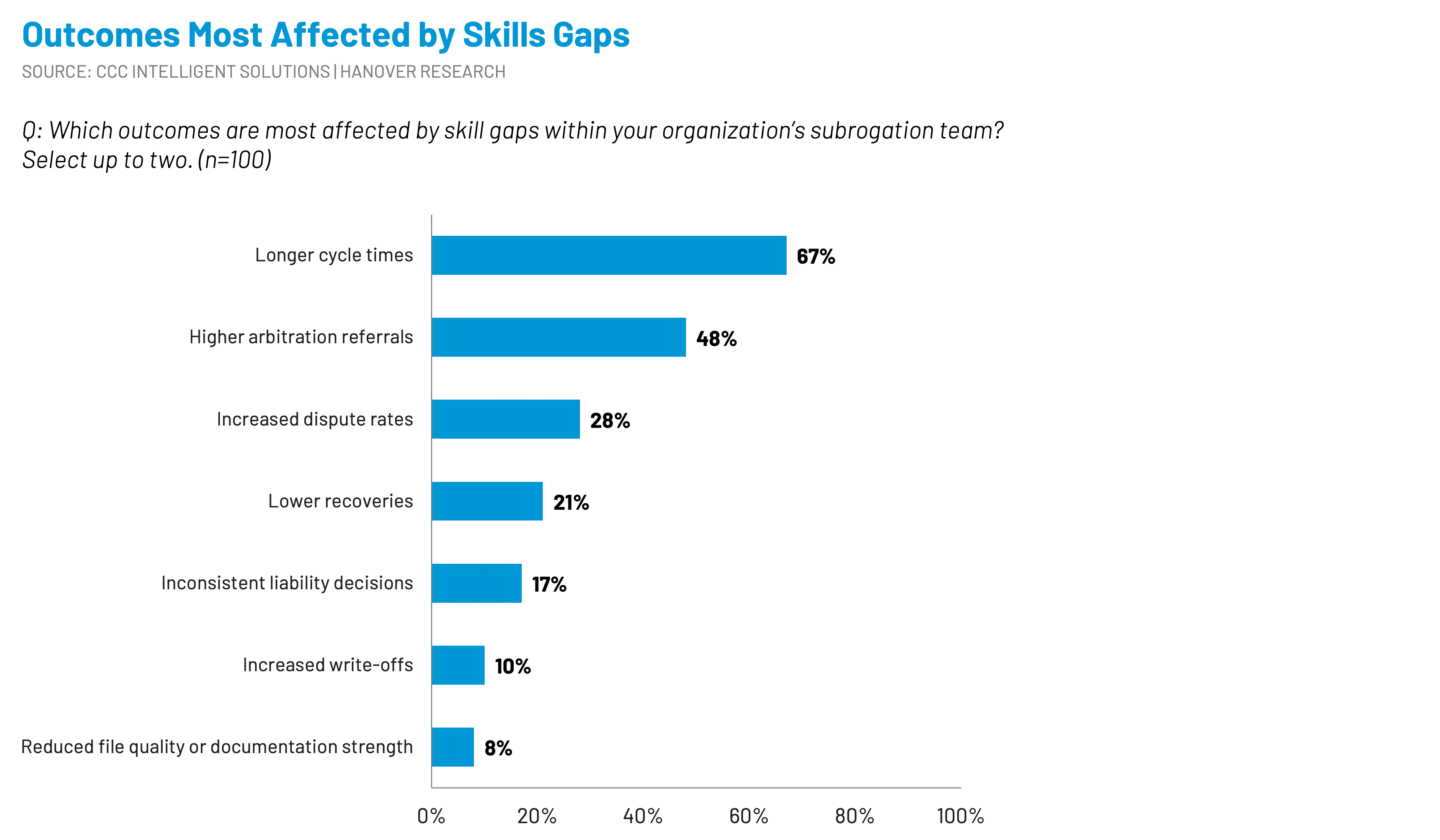
The downstream impact of this shift is measurable and it's creating bigger operational performance issues. 67% of study participants said skills gaps most often lead to longer cycle times, and 48% cited higher arbitration referrals. Increased dispute rates, lower recoveries, inconsistent liability decisions, and write-offs were also identified as consequences.
Missed Recovery Opportunities and Arbitration Pressure Are Raising the Stakes
Despite the mounting pressure, our study participants said they don't believe the subrogation function is fundamentally broken. Among the 23% of study participants who agreed that money is being left on the table due to inefficiencies (Figure 1), 87% said missed recovery opportunities were the primary source, while 70% cited incorrect or inconsistent liability decisions.
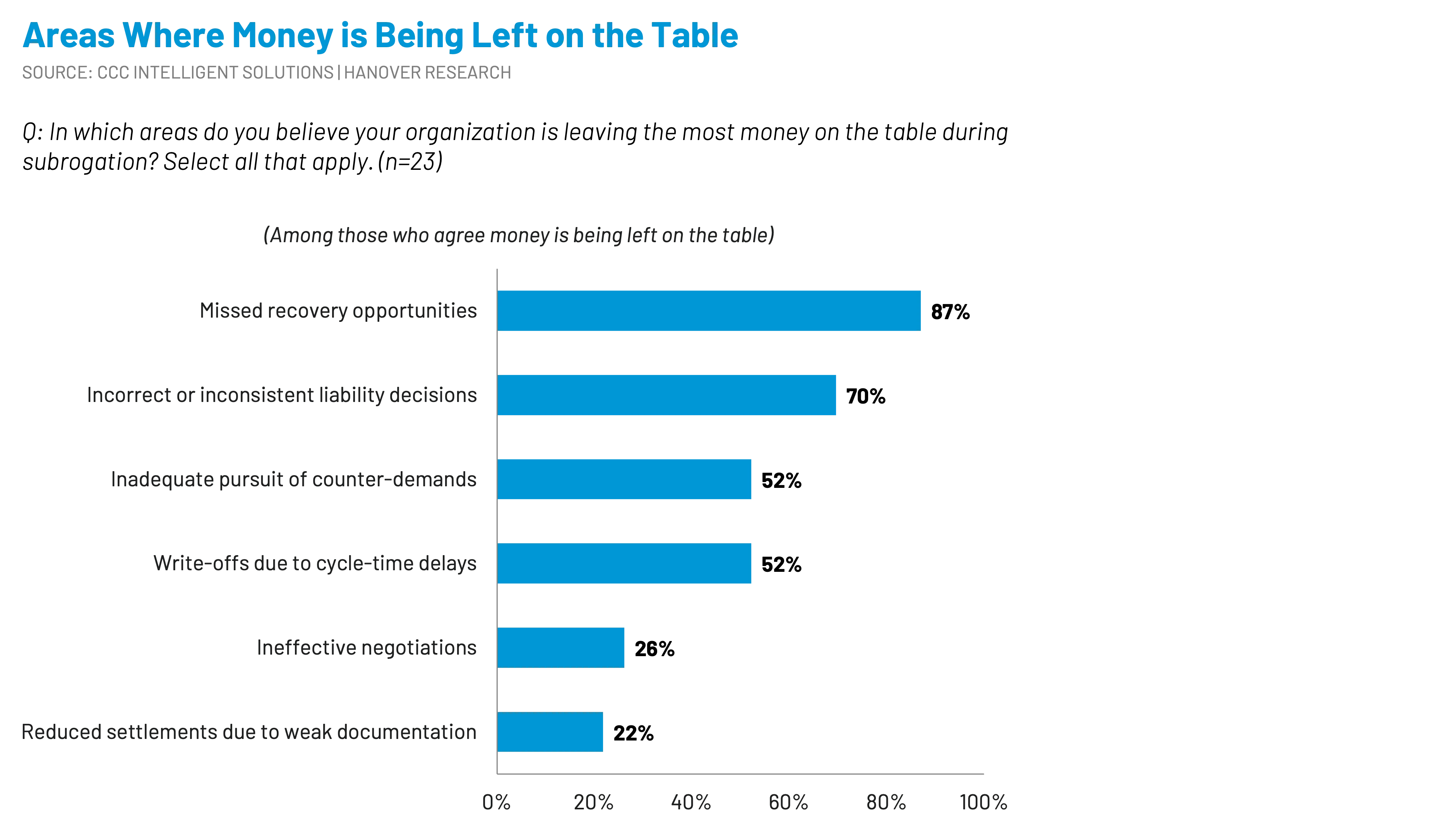
That distinction matters. Carriers may not view leakage as a shortcoming of the subrogation function, but the data suggests they see meaningful opportunity to improve outcomes by identifying recovery potential earlier and applying more consistent decision-making across files.
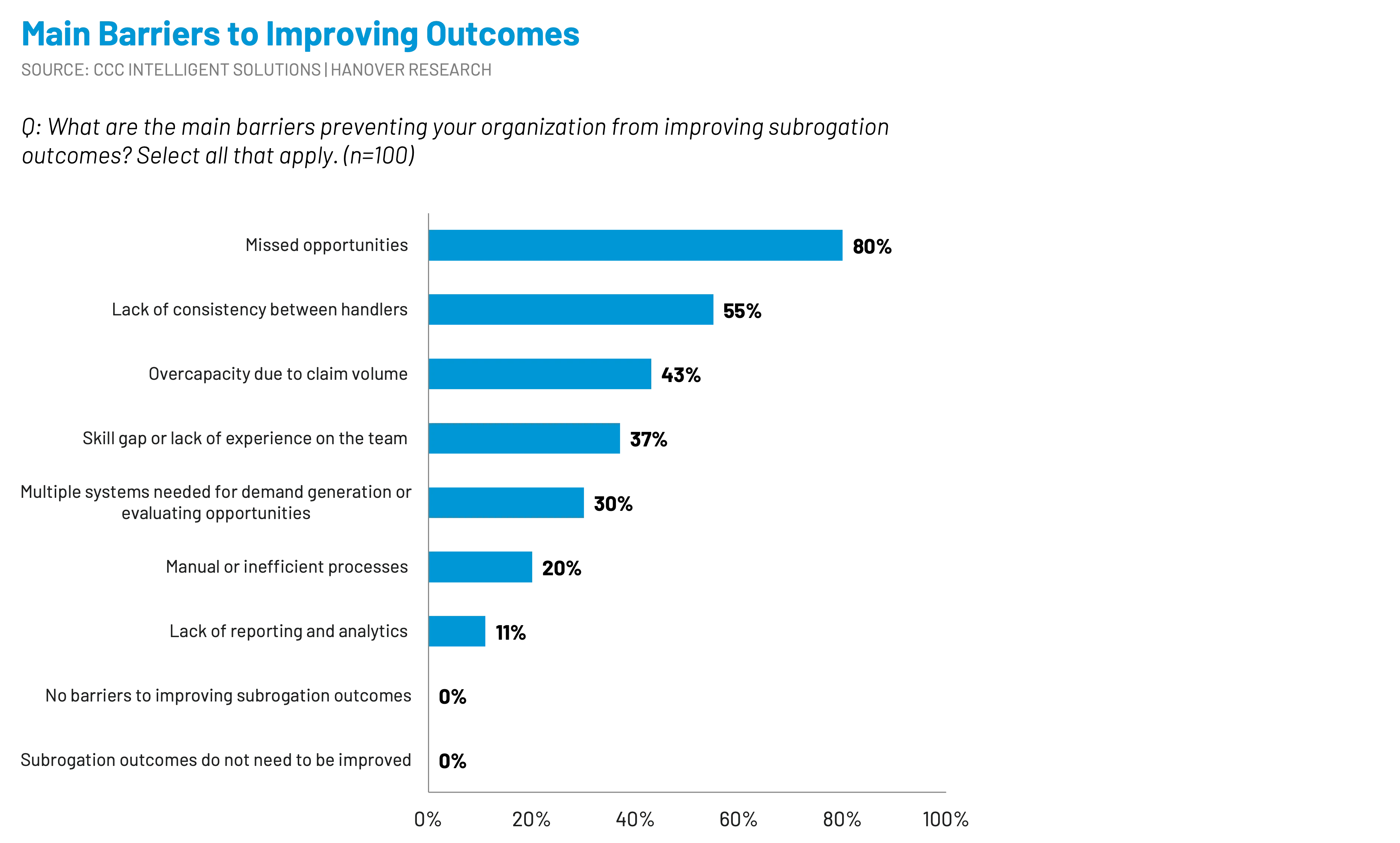
Across all respondents, missed opportunities were the top barrier to improving subrogation outcomes, cited by 80%. Lack of consistency between handlers followed at 55%, overcapacity due to claim volume was cited by 43%, and skill gaps or lack of experience on the team came in at 37%.
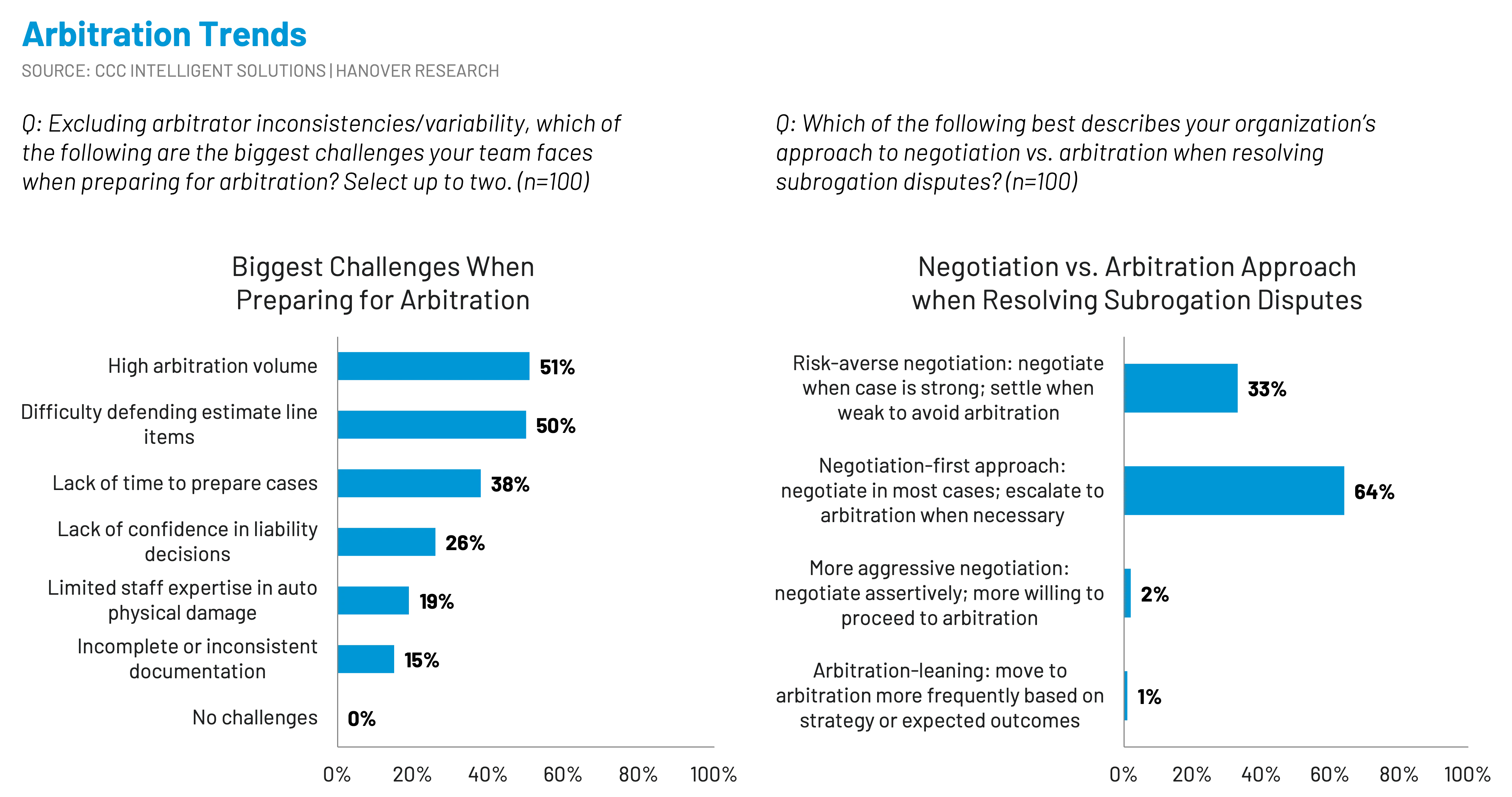
Lack of consistency can also increase arbitration pressure. Most organizations in the study indicated an aversion to arbitration. 64% described their approach as negotiation-first, escalating only when necessary, while 33% described themselves as risk-averse, settling weaker cases to avoid arbitration.
Yet arbitration continues to consume time and attention. Respondents cited high arbitration volume at 51% and difficulty defending estimate line items at 50% as the top challenges in arbitration preparation.
Study findings suggest that arbitration readiness cannot be treated as a late-stage subrogation activity. Stronger outcomes begin earlier in the workflow, when teams identify recovery potential, gather documentation, assess liability, evaluate estimate details, and prepare a defensible position before the file becomes more difficult to resolve.
A Shift in Subrogation Investment and AI Readiness
The study shows a clear inflection point in how insurers are prioritizing subrogation. As claim complexity increases and missed opportunities remain the top barrier to improved outcomes, subrogation is moving higher on the investment agenda.
In fact, 85% of respondents said their organization leaders see subrogation as a priority investment area, signaling that carriers are increasingly viewing this function as a measurable lever for recovery performance, operational consistency, and claims efficiency.
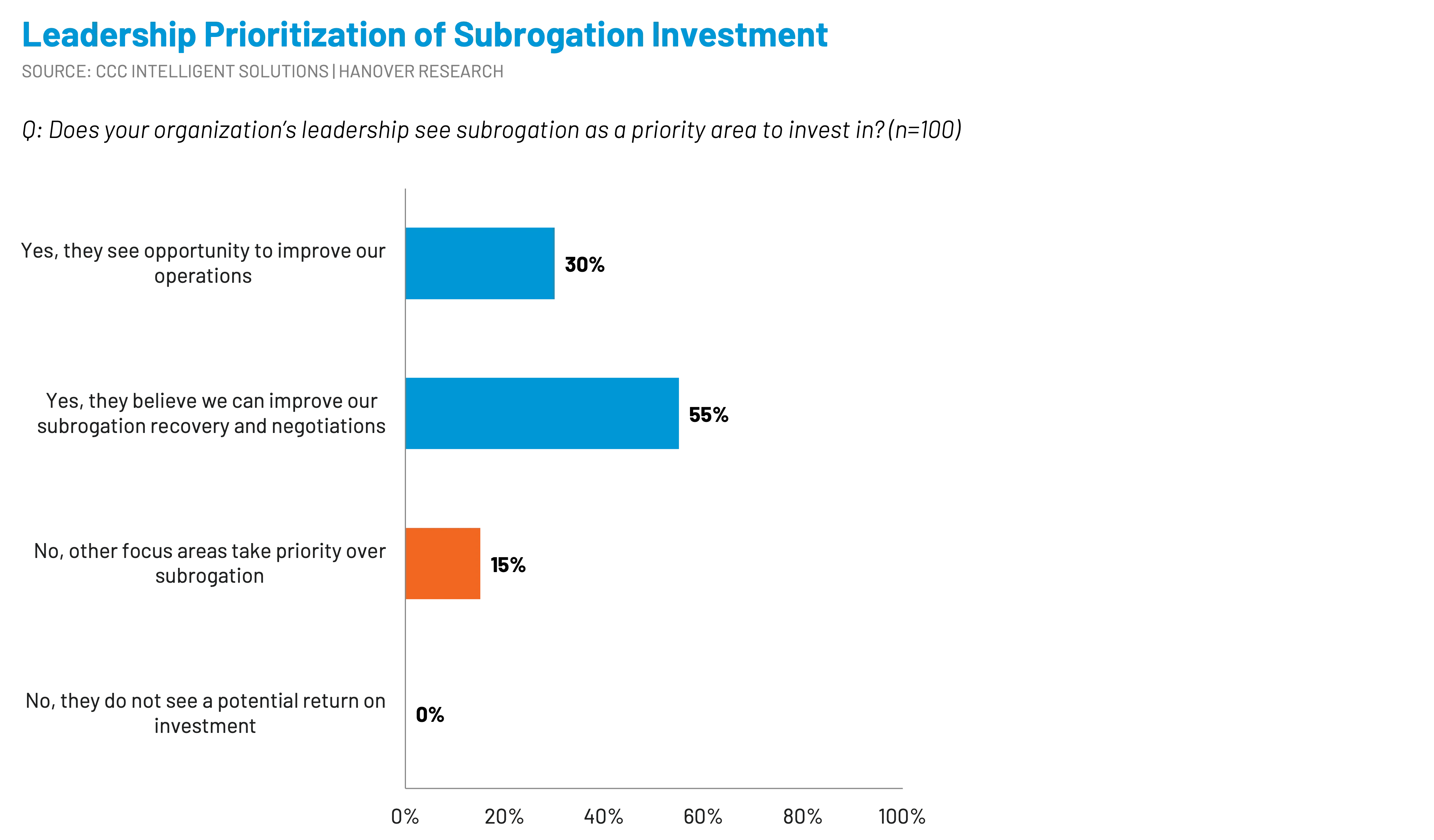
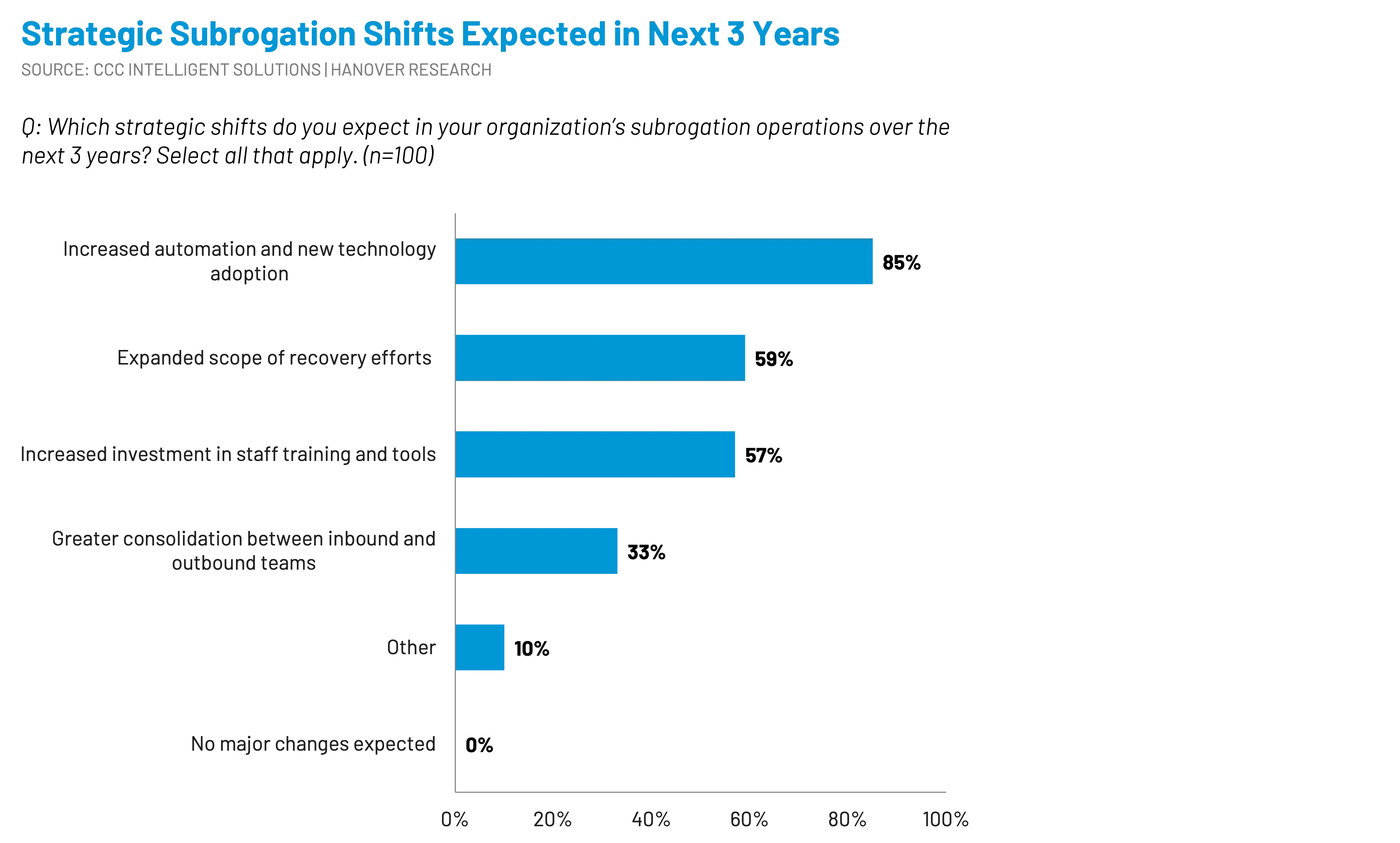
That prioritization is reflected in where organizations expect to focus over the next three years. 85% of respondents anticipate increased automation and new technology adoption, 59% expect an expanded scope of recovery efforts, and 57% expect increased investment in staff training and tools.
This may be indicative of an industry that’s taking a more integrated approach to improving subrogation outcomes by pairing automation with broader recovery strategies and workforce enablement. It also suggests carriers aren’t questioning whether subrogation needs to evolve -- they're focused on how to evolve it in a way that improves outcomes without weakening the expertise, accountability, and judgment the function depends on.
The data around subrogation teams' AI readiness reinforces this point. Nearly every study participant (96%) said their teams are either somewhat comfortable or very comfortable using AI-guided workflows or decision-support tools. Experienced and newer staff were also described as broadly supportive or receptive to adopting new technology, challenging the assumption that AI adoption will be slowed primarily by frontline resistance.
But readiness doesn't mean carriers are looking to automate subrogation indiscriminately – rather, the data indicates a more nuanced adoption environment. Insurers want AI that helps them do the work better, not simply move the work elsewhere or remove people from the process. They're focused on strengthening internal capacity, improving consistency, and giving teams better guidance at the moments where decisions have the greatest impact.
That distinction matters because the considerations around AI adoption are important. Privacy risks were cited by 88% of respondents, followed by accuracy or liability exposure at 54%, ethical considerations at 51%, and concern about replacing human judgment at 45%.
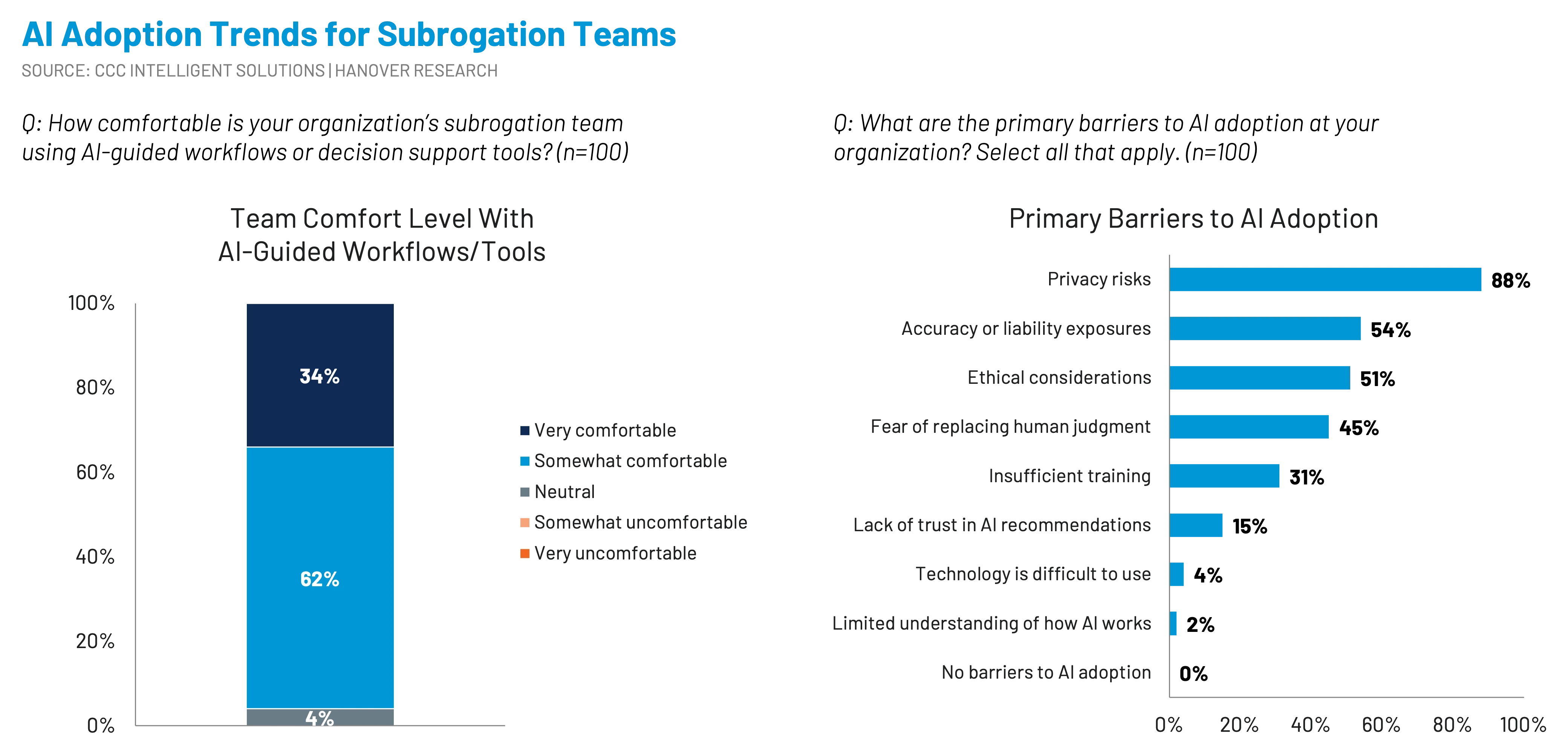
These barriers are less indicative of resistance and more reflective of the standards carriers expect AI-enabled tools to meet. Subrogation is judgment-intensive work and teams still need to assess liability, interpret estimates, evaluate documentation, negotiate effectively, and decide when escalation is warranted. The opportunity isn't for AI to replace subrogation expertise, but to make it more scalable, consistent, and actionable.
The Next Era of Subrogation: Timeliness and Consistency
The future of success of subrogation teams is predicated on how insurers address several key challenges: rising claim complexity, shifting workforce experience, growing arbitration demands, and the need to identify recovery opportunities earlier and more consistently.
Key findings from The Future of Auto Subrogation Claims Operations underscore the opportunity to turn subrogation from a reactive recovery function into a more connected, data-driven performance lever. The data shows that carriers have recognized this new reality and understand the importance of investing in the right people, processes, and technology to support this next phase of growth.